We give back to the land
what it gave us
Biodynamics is how you make a wine people still care about in five, ten, even twenty years.

At Zlatý Roh we do not play at “natural” wine. We have farmed organically since 2014 and are a certified organic winery. Since 2017 we have added biodynamic practices and the Demeter method on top of that.
What matters more to us than certificates is what we do in the rows.
We have cut out the chemical and mechanical shortcuts that modern farming brought in. No herbicides, no synthetic fertilisers, no systemic sprays. Soil is a living organism and we treat it as one. Looking after it is work measured in decades.
We farm thirty hectares above Devín Castle the way it used to be done.
begins
no shortcuts
and pastures
stabilizing dose
I. Philosophy
Soil is a living organism
We make our own preparations, composts and herbal infusions. We follow the rhythms of the moon, the sun and the planets when spraying and pruning. We see the vineyard as one connected living whole.
The goal is soil vital enough that the vines can handle drought, torrential rain and disease on their own. That is the main difference from conventional viticulture.
II. In the Rows
Animals instead of machines
Two draft horses, Uriáš and Barin, pull for us in the vineyard, and more are on the way. We do not do it for nostalgia. A horse does not compact the soil the way a tractor does. It is gentler, quieter, and in the rows it treats every vine with more care. The soil under its hooves stays porous and the organisms in it are left undisturbed.
Most of the important work still comes down to human hands, from pruning in February to harvest in September. Working with horses is slower, but that is exactly what we want. Patience that ends up in the wine.
“When I walk the rows with a horse, I feel like part of the vineyard. Not its master.”
Filip Nagy
III. The Preparations
What we give the soil
Biodynamics introduced this series of natural preparations back in 1924. They come from the mineral, plant and animal kingdoms. For biodynamics they are irreplaceable. The two best known use a cow horn as a natural vessel.
A cow horn is buried in the soil over winter. Inside, it ferments into dense humus full of microorganisms. In spring it is dug up and sprayed onto the soil, strengthening the roots and bringing the earth to life.
A cow horn filled with finely ground quartz is buried in the soil over summer. It is then sprayed onto the leaves at dawn. It improves photosynthesis and gives the plant light and ripeness.
Alongside them are six compost preparations made from herbs that mature in living soil.
We make them ourselves, on our own farm. Nothing bought, nothing substituted.
IV. The Cellar
No stainless steel, no shortcuts
Our cellars skip stainless steel tanks entirely. We use only natural materials: wood, terracotta and granite. Austrian Stockinger barrels, Italian clay amphorae and a large granite vessel we call the stone of life. Each material gives the wine something different. Wood breathes. Terracotta stabilizes. Granite protects.
Fermentation happens spontaneously, on the grapes' own yeasts. We neither fine nor filter the wine, so it represents its origin truthfully. Sulfur goes into the bottle only in a tiny stabilizing amount. A rule we consider our own standard of honesty.
“Nature knows best what to do. We simply stay out of its way.”
The Zlatý Roh philosophy
V. A Living Whole
A vineyard is more than vines
Part of the thirty hectares is fields and pasture. We keep a herd of Jersey cows, goats and poultry, and we keep bees. No animal here is decoration. Each one has a job in a closed farm cycle. Manure goes into the compost, compost onto the soil, soil into the grapes.
Biodiversity is rare in the urban setting of Bratislava. Devín, by its position, is an island of living countryside between the rivers and the castle rock. We work the vineyard also for the sake of a healthy landscape and the community of people who live in it.
VI. The Experiment
Own-rooted Frankovka
On one parcel of weathered granite with almost no topsoil, we are planting Frankovka without rootstock. The way vines grew before phylloxera. The inspiration was Loïc Pasquet of Bordeaux, who walks the same path. It is a project measured in decades, not a single season. What comes of it, only time will tell.
VII. The Future
A vineyard built to last
Climate change brings extremes the older winemakers in the region cannot recall. Higher sugar levels in the grapes, droughts, torrential rains. The vineyard has to be vital enough to handle it on its own.
in living soil
not sprays
in the soil
not seasons
Heritage
Four rows from the 1970s
During the 2014 restoration we came across four rows of St. Laurent in the old vineyards that had somehow survived all forty years of abandonment. We let them be. They are the oldest vines we have today.
Each year they give us roughly one barrel of wine. We do not sell it. We tend to give it to people who know what they are holding in the glass. It is proof that old vines can take more than you would expect.
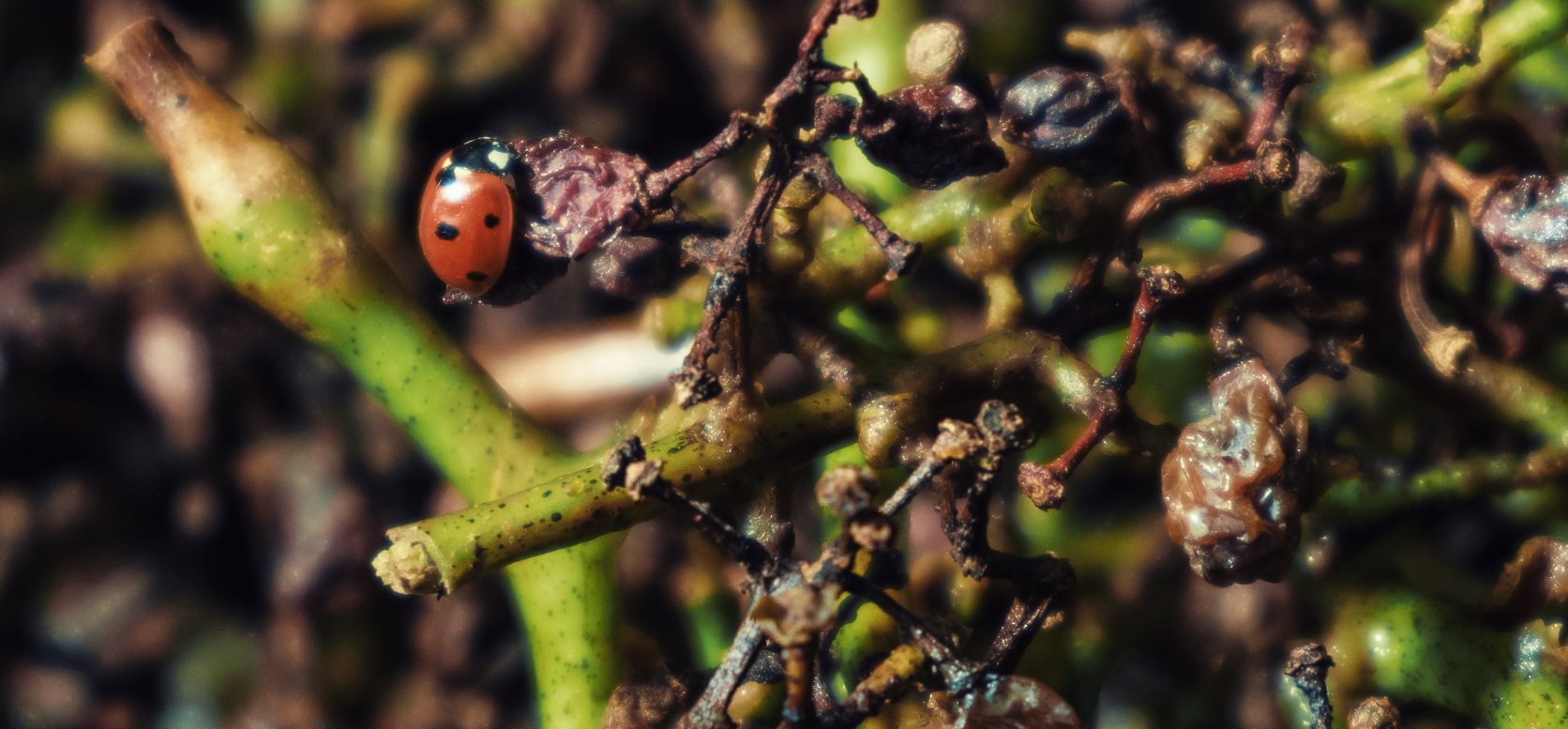
The rescued rows of St. Laurent. The oldest vines at Zlatý Roh.
VIII. Devín
A quiet renaissance
The other winemakers in Devín are colleagues to us. The more this region pulls together, the better it will be for the name of Devín terroir.
